
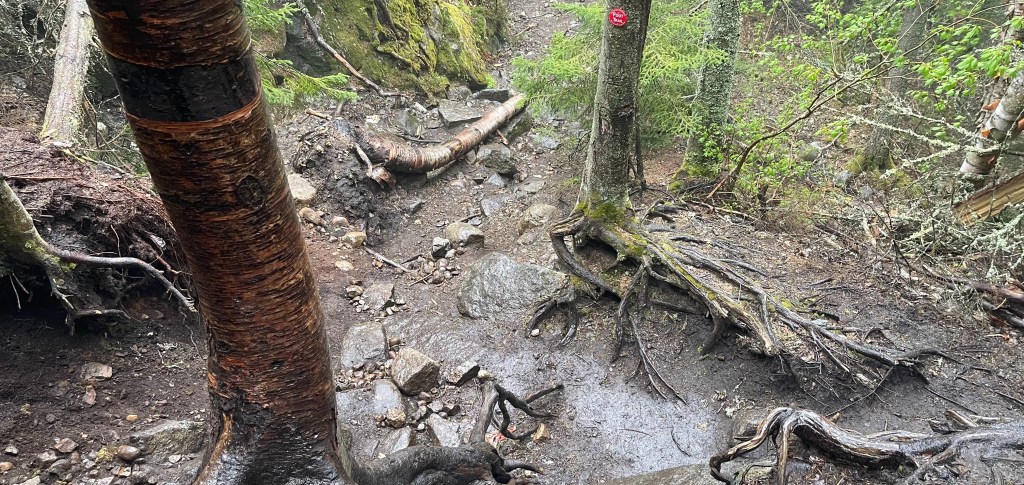
The New York State Department of Environmental Conservation issued their annual mud season advisory on April 7, 2022. This statement advises hikers to stay on trails below 2,500 feet. Higher elevation trails are still drying from the Winter thaw even though recent weather has been significantly warm. The mud season typically spans between the beginning of April and beginning of June.
In this post i want to talk about what mud season means for hikers and for the Adirondack wilderness. I did not know until recently that hiking during mud season on higher elevation trails has such a negative impact on the environment. So i’d like to spread that knowledge to others who might be in the same boat as me.
First off, what are trail conditions like during the mud season? The DEC states in their advisory that trails above 2,500 feet still contain slowly melting snow and ice. While snow and ice is melting it is often rotten. Rotten snow is course, full of particles, icy and wet in some spots, and does not support weight that well. This means that you will often sink into the snow and get your shoes (and lower body) wet which can lead to hypothermia in cold weather conditions. Another thing to keep in mind is that weather can change quickly in the Adirondacks. It might be sunny and warm down below, but in the mountains it could start snowing and temperatures could drop.
During the springtime there is also the risks of avalanches in the mountains. Mild temperatures and high winds are perfect conditions for avalanches. Unstable snow also increases avalanche risk. Snow that cracks, collapses, or makes hollow sounds is unstable.
Water levels rise during springtime because of the snow and ice melt. This is important to note because you might be able to cross a stream in the morning and then find that in the afternoon the stream has flooded. So keep this in mind when planning your hikes.
Hiking during the springtime also leads to erosion and widening of hiking trails. This is because people oftentimes walk off trail to avoid mud or other obstacles along the trail. The NYSDEC High Peaks Unit Management Plan states that the width of a foot path should be no larger than two feet wide, however certain trails in the High Peaks have widened to 25 feet. This widening of the trails have been due to the amount of hikers in the area, especially during the muddy spring hiking season. For this reason it is important to stay on the trail and walk through mud instead of off the trail. You can wear gaitors to minimize the mud that gets on your shoes/legs. If you are not able to walk through the mud on these trails then maybe consider not hiking during mud season.
If you are heading out in the Adirondacks to hike, then here is some advice:
- Walk through the mud. You can wash your shoes and clothes later. Keep in mind that this is what is best for the environment. Also, if your shoes are wet and muddy take extra caution when walking on smooth surfaces.
- Consider wearing waterproof boots and bringing extra socks to change into.
- Bing warm clothes, crampons, micro spikes, and trekking poles.
- Plan ahead and know if and where you will have to cross water. The National Weather Service has a great site where you can track the precipitation a certain area will receive/ is receiving.
- Consider hiking on lower elevation trails, but be weary that spring time hiking anywhere still has its risks.
The NYSDEC specifically states to avoid the following trails:
- High Peaks Wilderness – all trails above 2,500 feet specifically Algonquin, Colden, Feldspar, Gothics, Indian Pass, Lake Arnold Cross-Over, Marcy, Marcy Dam – Avalanche – Lake Colden, which is extremely wet, Phelps Trail above Johns Brook Lodge, Range Trail, Skylight, Wright, all “trail-less” peaks, and all trails above Elk Lake and Round Pond in the former Dix Mountain Area;
- Giant Mountain Wilderness – all trails above Giant’s Washbowl, “the Cobbles,” and Owl Head Lookout;
- McKenzie Mountain Wilderness – all trails above 2,500 feet, specifically Whiteface, Esther, Moose and McKenzie Mountains;
- Sentinel Range Wilderness – all trails above 2,500 feet, specifically Pitchoff Mountain; and
- Jay Mountain Wilderness – specifically Jay Mountain.
I would also like to note that i think people should be free to hike anytime during the year. However, i also think it is important to know how your decisions impact the trails, which is my reason for writing this post.

 Hannah the hiker
Leave a comment