
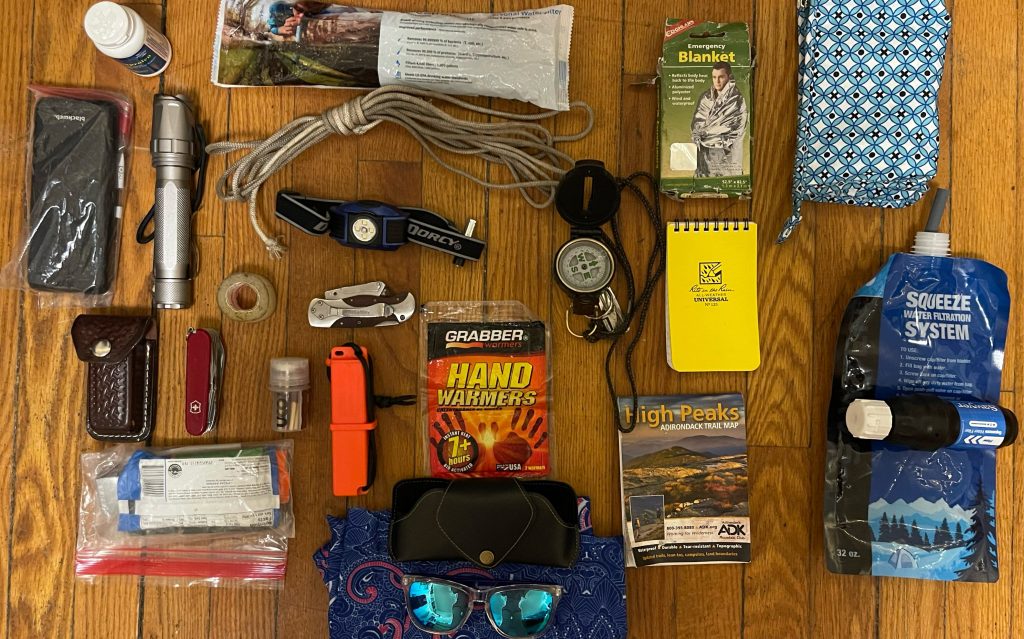
In this post I want to outline what I bring with me when I go hiking alone. Hiking by yourself is an invaluable experience and I think that more people should get “out there” alone with the right gear of course. so, I will talk about what I bring, why, and offer some advice on going into the woods by yourself. My outdoor experience is limited to the Adirondacks in New York, so depending on where you live the necessary gear may differ.
Gear:
Hiking compass: Since the trails I have been on have been relatively well marked I have not needed to use my compass. However, before I started hiking alone a lot my dad gave me a crash course on how to use the compass he gave me. (a compass is kind of useless unless you actually know how to use it) knowing how to use the compass and having it in my pack at all times offers security to my parents and i, since this mitigates the chances of me going off trail or getting lost. so, always have one in your pack and know how to use it with the maps you are using. Here is a link to an article that describes how to use a hiking compass.
Emergency blanket: an emergency blanket is one of the best things you can bring with you anytime you go hiking. I t can be used for more than just a way to keep warm. You can use it as a ground tarp, sign, trail marker, rain poncho, pack liner, and socks. They run pretty cheap and are lightweight, so there is no reason to not have it in your pack at all times.
Stormproof matches/fire starter kit/lighter: In the Adirondacks you are not allowed to have campfires but I still carry matches or a fire starter kit. There could be times where I am in a pinch and absolutely need to build a fire. obviously fires help you keep warm but if you can’t filter water you can use the fire to boil water and make it drinkable. When I first started camping on my own I had no idea how to build a fire and had my dad give me several lessons on how to build a fire in any weather condition. do not wait until you are on some camping trip to learn, read, watch videos, and ask your dad now so that when you get out there you know what you are doing. practice before you need it! I always carry a little pill bottle of kindling my dad gave me and tealight candles which work great to get a fire going. This article gives a bit of an overview on building a fire in crappy weather. Whenever I think/talk about building fires I am always reminded of Jack London’s short story “To Build a Fire.” it’s a pretty great read, and may scare you into being more prepared to head outdoors on your own.
Hand warmers: I always carry hand warmers with me since they work great to warm up my hands and feet. You can also use them to thaw out small amounts of water, warm your sleeping bag, and to keep batteries from getting too cold to work. I haven’t had to use these before but I feel safe knowing that they are in my pack in case I ever need them. You can buy them in bulk for cheap, and they don’t take up much space or weight so this is another item you should keep with you.
LifeStraw/sawyer squeeze: Whenever I go hiking I always carry a 2L bladder bag full of water and at least one other 32 oz water bottle. Normally this is enough water for me, but it is good to be prepared to make more drinkable water if you need it. I t is recommended that people drink about 2 liters of water a day, and obviously this amount increases when you are exercising. I bring my LifeStraw with me which I can stick in any water and be able to drink safely. The straw is a microfilter with a pore size of 0.2 micrometers which removes parasites, bacteria, dirt, and microplastics. I never drink from any natural water source on the trail without filtering it first. just because the water is moving or is “clear” doesn’t mean that it won’t make you sick. The only downfall of the LifeStraw is that it is pretty inconvenient when you need to filter large amounts of water, so for that reason I bought a sawyer squeeze. The sawyer squeeze is a portable water filter. The microfilter’s pore size is 0.1 micron, it removes 99.99999% of bacteria like e.colI and salmonella 99. 9999% of protozoa like giardia. I t also filters out microplastics. I t is really compact and easy to use since the instructions to use and care for the device are printed right on the filter bag. Both the LifeStraw and sawyer squeeze are water filters, not water purifiers. REI has a great article about the types of water treatment people commonly use on the trail, which I suggest looking over when choosing what system will work best for you. water treatment systems can get pretty expensive, but consider it an investment into your health and safety on the trail. always make sure you have a way to access drinkable water since it is something your body absolutely needs, especially if you are exercising. Plus, drinking untreated water can cut your adventure short if you get sick, and none of us want that to happen.
Swiss army knife/box cutter: My dad has let me use his swiss army knife indefinitely, and I keep it in my pack for any hike I go on. It’s a multi-purpose knife that includes small scissors, knife, nail file, and other helpful tools. I also carry a box cutter which is a pretty big knife and use it mostly for safety. Since I am in the woods alone it makes me feel better to have a big knife on my hip pack for easy access. I also sleep with this in the pocket of my sleeping bag for easy access. Both knives are effective tools to have if you need to gather kindling or fuel for a fire, repair gear, and in first aid scenarios.
Rope: I carry a couple feet of rope in my pack for a number of reasons. If I ever need to stay the night in the woods and don’t have the appropriate food bag or bear canister, rope works to hang my pack high up in a tree away from bears. rope also works to repair gear, for first- aid, and in case I need it to get over tough sections of a trail. it might take up a bit more space or weight in your pack but it is worth it.
Extra food: I never really know how hungry I will be when I am hiking, so I always pack more food than probably necessary. I always pack a peanut butter and jelly sandwich as well as granola bars, trail mix, dried fruit, hydration mix or energy chews, some sort of candy, and packets of peanut butter. you never know if you will need the extra food, so it’s better to be safe than sorry in my opinion. it will take up space and weight but honestly isn’t a negotiable part of gear to me.
Extra clothes: Even when I was hiking in the summertime, I always brought extra clothes and layers with me. These extra clothes include extra wool socks, a rain jacket, and pants. If you are sweating through your clothes in warm weather it is important to change into dry clothes or else the damp shirt or pants will just make you even colder. Even if it isn’t raining, I pack a rain jacket which will trap my body heat in and keep me warm. extra socks are great for wet or cold feet and honestly just feel good to change into for the last couple miles of a hike. Before you start going out hiking you should know how to layer your clothes properly. I stick with a base layer (wicks sweat off skin), middle layer (retains body heat and protects from cold), outer layer (shields from wind and rain).
Flashlight/headlamp/batteries: A headlamp comes in handy if you are starting or ending your hike in the dark. I carry extra batteries for the headlamp and flashlight as well.
Portable charger: I use a portable charger that will charge my phone 3 times. I take lots of pictures on my hikes so having the charger on long hikes ensures I can take pictures and videos and still have the phone available to call for help (if there is service).
First aid kit: I carry Band-Aids, medical tape, alcohol wipes, gauze, and ibuprofen. I t’s pretty limited and I stuff it all into an ibuprofen bottle. it is all good stuff to bring with you just in case you run into an emergency.
Map: Wherever I am hiking I bring a printed map of the area that I am in. I normally go hiking in the Adirondacks so I brought that printed map with me. I t’s a great navigation tool and helps me plan my hikes. maps are also a great way to familiarize yourself with the area you will be adventuring in!
Sunglasses/hat: Sunglasses and hats are a great way to protect yourself from the sun, which also helps you stay cool and comfortable when hiking.
Duct tape: Duct tape is super versatile, as I am sure you already know. I t works to repair gear and can work in a pinch to make some sandals. I wrap some around my ibuprofen bottle so it takes up less space.
Bandana: I normally use my bandana to hold my hair back or wipe sweat from my face. I t also works as a prefilter for water and can be used in first aid scenarios. These run pretty cheap and are very lightweight so they are worth keeping in your pack.
This is just a brief and basic summary of the gear that I think is important to bring when you hike alone. Of course, gear needs to change with the activity you are doing and where you are heading outside, so always do research before you head out. I hope that this was informative and helps you plan your next adventure alone.

 Hannah the hiker
Leave a comment